

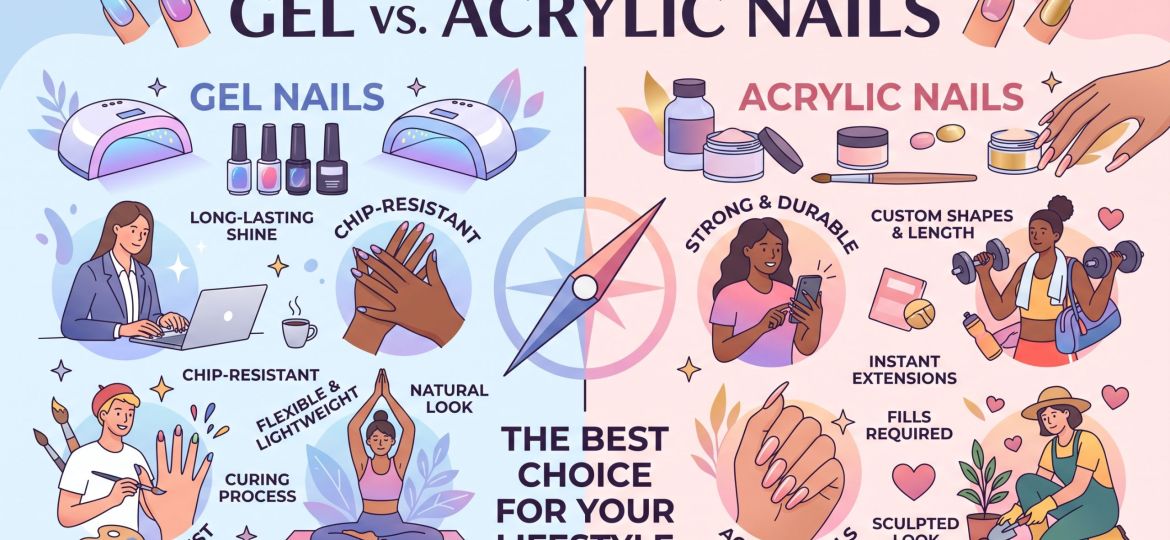
If you’re weighing gel vs. acrylic nails, the short answer is: gel is the better choice for natural-looking, flexible enhancements that are easier on your nail plate, while acrylic is the stronger, more durable option for significant length and heavy wear. But the right decision depends on your daily routine, your natural nail condition, and how often you want to visit a salon in Guelph. This guide breaks down the real differences, costs, and maintenance so you can book your next appointment with confidence.
Understanding the Core Differences: Gel vs. Acrylic
Both gel and acrylic systems use a polymer to create a hard layer over your natural nail, but their chemistry and application methods differ drastically. Acrylic is a liquid monomer and powder polymer combination that hardens when exposed to air. It creates a rigid, heavy layer that requires filing to shape. Gel is a pre-mixed resin that cures under a UV or LED lamp. It is applied in thinner coats and has a slight flexibility once cured, which mimics the natural nail more closely.
Your nail technician’s skill level matters more than the product line itself. In Guelph, salons like Fresh Salon and Spa By Holly use a level system for technicians, meaning a Level 4 specialist charges more than an Entry-level provider. That price difference often reflects experience with sculpting, in-fill techniques, and cuticle care—not just the brand of monomer or gel used.
Application Process and Time Commitment
A full set of acrylics typically takes 60 to 90 minutes. The technician mixes a bead of liquid and powder, places it on the nail, and quickly sculpts before it hardens. Then comes the filing—sometimes 15 minutes of dust-creating work to shape the apex and sidewalls. Gel application takes a similar amount of time for a full set, but there is less filing because the gel is self-leveling. Each layer is cured under a lamp for 30 to 60 seconds, which adds up but produces a smoother finish.
Durability and Wear: What Holds Up in Real Life
Acrylic wins on raw strength. If you type on a keyboard all day, garden, or tend to use your nails as tools, acrylic will resist bending and cracking better than gel. The structure is non-porous once fully cured, so it holds up well against water exposure. However, that rigidity has a downside: when you hit an acrylic nail against a hard surface, the impact transfers directly to your natural nail underneath, which can cause bruising or a torn nail bed.
Gel is more forgiving. It has a slight flex, which means it absorbs minor impacts without breaking the seal between the enhancement and your natural nail. But gel is not indestructible. Thin gel overlays can chip at the free edge, especially if you are hard on your hands. For most office workers and parents in Guelph, a structured gel manicure with a builder base lasts two to three weeks without lifting.
Signs You Need a Fill or Repair
Regardless of which system you choose, you will need maintenance every two to three weeks. The most common mistake is waiting too long between appointments. As your natural nail grows, the enhancement moves forward, creating a lever arm. That leverage increases the risk of breakage, especially with acrylics. If you see lifting at the cuticle area or feel a snag when you run a sweater over the nail, book a fill immediately. Do not try to glue a lifted nail back down at home—that traps moisture and bacteria under the enhancement.
Impact on Natural Nail Health
This is where gel and acrylic diverge significantly. Acrylics require aggressive filing of the natural nail surface to create a rough texture for adhesion. This removes the shiny top layer of the nail plate. If you remove acrylics improperly—by prying or peeling—you can strip away multiple layers of your natural nail, leaving them thin, ridged, and painful for months.
Gel systems, particularly builder gels, require less surface preparation. Your technician will gently buff the nail to remove shine, but the goal is to preserve as much natural nail thickness as possible. Soak-off removal is also gentler with gel. You wrap the nails in acetone-soaked cotton for 10 to 15 minutes, and the product softens enough to scrape off with a cuticle pusher. Acrylics take 20 to 30 minutes in acetone and often require more scraping force.
If your natural nails are already brittle, peeling, or damaged from a previous set, ask for a gel overlay instead of a full acrylic set. The flexibility of gel will allow your natural nail to bend slightly rather than snap under pressure. In contrast, acrylic over weak nails can cause the natural nail to break at the stress point where the enhancement ends.
Cost Comparison and Salon Pricing in Guelph
Pricing in Guelph varies by salon and technician level. At Fresh Salon and Spa By Holly, the level system (Entry through Level 4AA) directly affects the price you pay. A basic gel manicure with polish starts around $60 to $70. A full set of gel extensions with a builder base runs $80 to $100. Acrylic full sets are often slightly cheaper initially—around $70 to $90—because the raw materials cost less. However, the price gap narrows when you factor in the skill of a senior technician who can sculpt a thin, natural-looking acrylic without bulk.
Beware of bargain pricing. A full set for $35 at a walk-in salon usually means rushed application, poor cuticle prep, and thick product that looks fake. You will pay more in the long run for repairs and damaged natural nails. A quality set, whether gel or acrylic, should look like an extension of your own nail with a smooth apex and no visible lifting at the cuticle.
Style and Aesthetic: Which Looks More Natural?
Gel is the clear winner for a natural look. Because it is applied in thin layers and self-levels, it creates a smooth, glass-like surface that reflects light similarly to a healthy natural nail. You can wear a sheer or “nude” builder gel that strengthens your nail without adding obvious length or color. This is a popular choice for brides, healthcare workers, and anyone who wants a clean, polished look without the obvious “fake nail” appearance.
Acrylics can also look natural, but only in the hands of an experienced technician. The key is the apex—the highest point of the nail arch. A skilled tech will build the apex over the stress area (the center of the nail) to create a subtle C-curve. Poorly done acrylics have a flat or overly thick profile, which looks bulky and unnatural. If you want a dramatic shape like stiletto or coffin, acrylic is often the better choice because it sculpts more easily into sharp, precise edges that gel cannot achieve without adding excessive bulk.
Color Options and Artwork
Both gel and acrylic can be painted with regular polish, gel polish, or dipped in powder. The difference is in the extension itself. Gel extensions are pre-colored in some systems, allowing for a sheer or opaque finish without additional polish. Acrylics are typically clear or pink/white for French tips, then covered with polish. For intricate nail art, gel provides a smoother canvas, and your artist can cure layers of color without smudging. Acrylics are better for 3D sculpted art, like flowers or bows, because the product is workable before it hardens.
Removal Process and Transitioning Between Systems
Removal is a critical factor if you plan to switch between gel and acrylic or take a break from enhancements altogether. For gel, the soak-off process is straightforward. Your technician files off the top coat to break the seal, soaks your nails in acetone for 10 to 15 minutes, and gently pushes off the softened gel. Your natural nail underneath should be intact, though slightly dehydrated from the acetone.
Acrylic removal is more involved. The product is harder and requires a longer soak—up to 30 minutes—and more scraping. Some salons use an electric file to remove the bulk of the acrylic before soaking, which saves time but requires a skilled hand to avoid damaging the natural nail. If you are transitioning from acrylic to gel, wait at least one week without any enhancement to let your natural nails rehydrate. Apply cuticle oil twice daily during that break.
Making the Right Choice for Your Lifestyle
Consider your week ahead. If you are a nurse, a hairstylist, or a mom of young kids who washes hands frequently, gel is the practical choice. It is more flexible, less likely to snag on hair or fabric, and gentler on your natural nails if you accidentally catch them. If you are preparing for a vacation, a wedding, or a special event and want guaranteed length and shape for three weeks, acrylic is the safer bet. It will not chip or bend under the stress of packing, swimming, or dancing.
Your natural nail condition also matters. If your nails are long and healthy, a gel overlay alone provides strength without added length. If your nails are short, peeling, or you bite them, you need a full set of extensions—either gel or acrylic—to create a base for growth. Acrylic is often recommended for nail biters because the hard surface acts as a physical barrier, but you must commit to fills every two weeks to prevent breakage.
Frequently Asked Questions
Can I switch from acrylic to gel without damaging my nails?
Yes, but you need a break between systems. Have your acrylics soaked off professionally, then wait 7 to 10 days before applying gel. During that time, keep your nails short and apply cuticle oil several times daily. The natural nail needs to rehydrate and regain strength before bonding to a new enhancement.
Which lasts longer between salon visits?
Acrylics generally last longer without lifting—up to four weeks for some clients—because the bond is stronger. Gel starts to lift at the cuticle after three weeks, especially if you are oily-skinned or use hand sanitizer frequently. However, waiting four weeks between fills is not recommended for either system. Book every two to three weeks to maintain the structure and prevent breakage.
Are gel nails more expensive than acrylic in Guelph?
At most Guelph salons, gel extensions cost 10 to 20 percent more than acrylic full sets. The higher price reflects the cost of the product and the lamp cure time. However, if you factor in the cost of repairing damaged natural nails from poorly applied acrylics, gel is often the more economical choice in the long run.
Ultimately, the best choice between gel and acrylic nails comes down to your daily habits and your tolerance for maintenance. Gel suits clients who want a natural, flexible enhancement that is kind to their nail beds. Acrylic suits clients who need maximum durability and are willing to accept a firmer, heavier feel. Whichever you choose, book with a technician whose experience matches your expectations. A well-applied set, whether gel or acrylic, should feel comfortable, look elegant, and never cause pain. If you are still unsure, ask your nail technician at your next appointment in Guelph to do one hand in each product so you can compare the feel and look before committing to a full set.